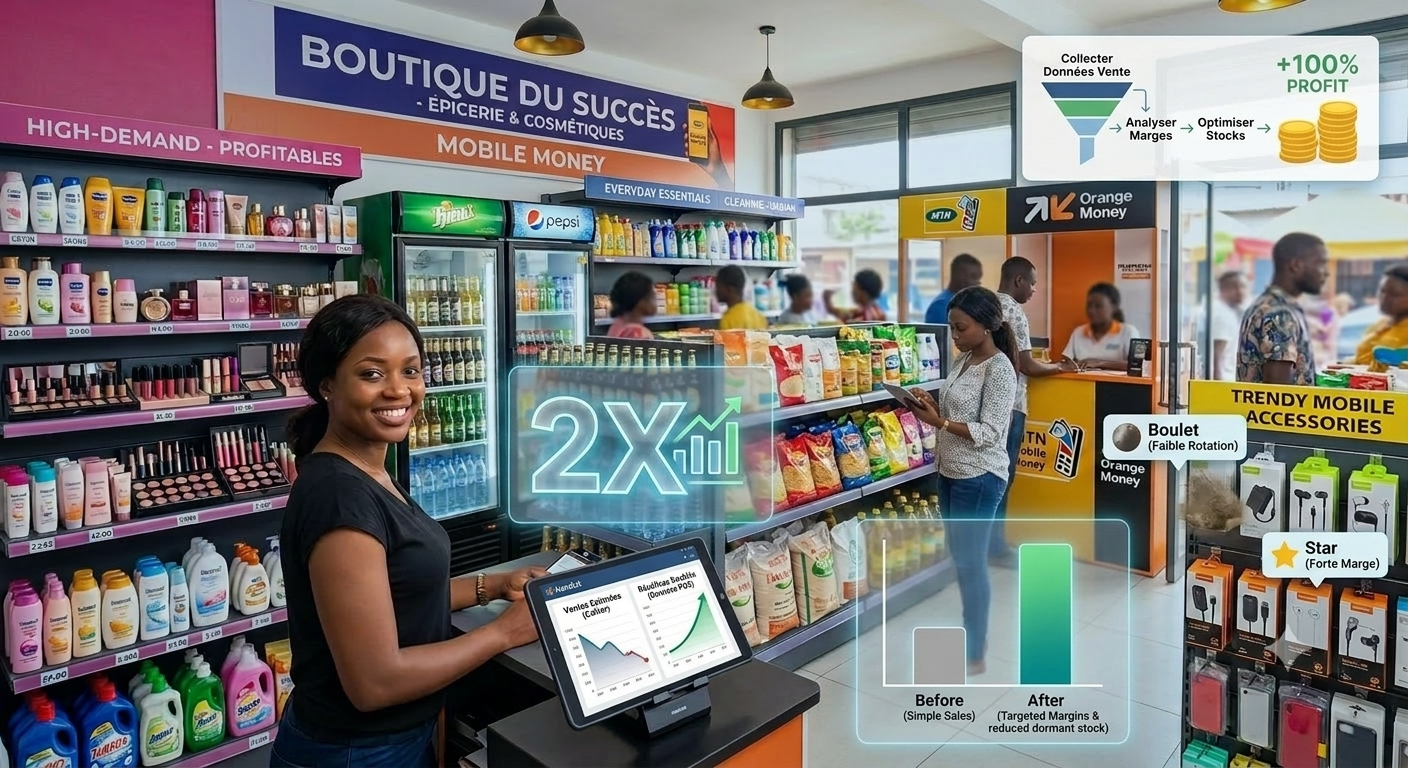
How to Use Sales Data to Double Your Store's Profits in Cameroon
Learn how to analyze your sales data to maximize your margins, eliminate dormant stock, and double your business profits in Cameroon.
How to Use Sales Data to Double Your Store's Profits
Many merchants in Cameroon still operate on "gut feeling".
They open their store in the morning, collect money from customers, pay suppliers, and hope there will be a profit left at the end of the month. However, managing a business this way is like driving a car with your eyes closed: the risk of a financial accident is huge.
By 2026, the difference between a shop that survives and one that skyrockets its profits lies in one word: data.
Your daily sales hide valuable information. If you learn to read them, you can literally double your business profits without necessarily doubling your customer count. Here’s how.
1. Identify (and Nurture) Your "Star" Products
Not all sales are equal. In your store, a minority of products generates the majority of your actual profits. This is known as the Pareto principle (the 80/20 rule).
By analyzing your sales data, you need to classify your products into three categories:
The Stars: High margin, high turnover (they sell quickly and generate substantial profits).
The Attractors: Low margin, high turnover (items like rice or sugar that draw customers in).
The Anchors: Low margin, low turnover (these sit untouched on the shelf).
Action to Double Your Gains: Once you've identified your "star" products (often cosmetics, phone accessories, or specific brands), showcase them prominently! Place them at eye level, near the cash register, and ensure you never run out of stock on these items.
2. Eliminate Costly Dust: The Hunt for Dormant Stock
A product that has sat on the shelf for six months isn’t neutral: it's money sitting idle. This blocked cash flow prevents you from purchasing the trending new products on the market.
With rigorous data tracking, you can instantly spot items that aren’t moving.
What to Do with Dormant Stock?
Don’t let them lose value. Use the data to take action:
Bundle Sales: Pair a "anchor" product with a "star" product by offering a slight discount.
Launch Flash Promotions: Liquidate them at cost if necessary to recoup your capital and reinvest in what works.
3. Adjust Prices Smartly (Dynamic Pricing)
If you set your prices only by adding a fixed percentage to the cost price, you’re missing out on significant profits.
Analyzing your sales history allows you to understand your customers' price sensitivity:
For essential goods (bread, oil), the customer knows the price by heart. If you increase it by 50 FCFA, they will go elsewhere.
For impulse or specialty products (accessories, niche cosmetics), the customer is buying a solution or pleasure. There’s more flexibility here.
By analyzing peak demand times (weekends, paydays, holidays), you can adjust your prices to capture maximum margin when customers are most willing to spend.
4. Anticipate Instead of Reacting: Predictive Inventory Management
The worst enemy of profitability is stockouts. When a loyal customer comes to find their product and your shelf is empty, you not only lose that day's sale but also risk losing the customer to your competitor.
By analyzing sales data over several months, you will see clear cycles. You’ll know exactly when during the year, month, or week demand peaks. This way, you can order just the right amount from your suppliers, neither too early (to avoid tying up cash flow) nor too late (to prevent stockouts).
HandLit POS: The Dashboard that Turns Your Numbers into Cash
Doing these calculations manually with a notebook and pen is a nightmare and a source of errors. This is where a modern management system becomes essential.
With HandLit POS, you no longer need to be an accounting expert to understand your sales data. The software works for you:
Automatic Margin Reports: You will visually see which categories (groceries, cosmetics, accessories) yield the highest net profits.
Critical Stock Alerts: The system warns you before you run out of stock on your key products.
Clear Sales History: You can quickly identify your "star" products and dormant stock.
Merchants who double their profits by 2026 aren’t working harder; they’re working smarter. They let data guide their purchasing, pricing, and organization.
FAQ
How can sales data increase my profits? It enables you to invest your money only in products that sell quickly and yield good margins, while avoiding losses related to expired or unsold products.
Do I need an expensive computer to track my data? No. Modern solutions like HandLit POS work on simple terminals or tablets that fit the realities of shops in Cameroon.
Where should I start if I want to analyze my business? Start by accurately tracking your gross margin (Selling Price - Purchase Price) for each product sold, rather than just looking at the total revenue.
Get our tips
Tips for better managing your shop, delivered straight to your inbox.