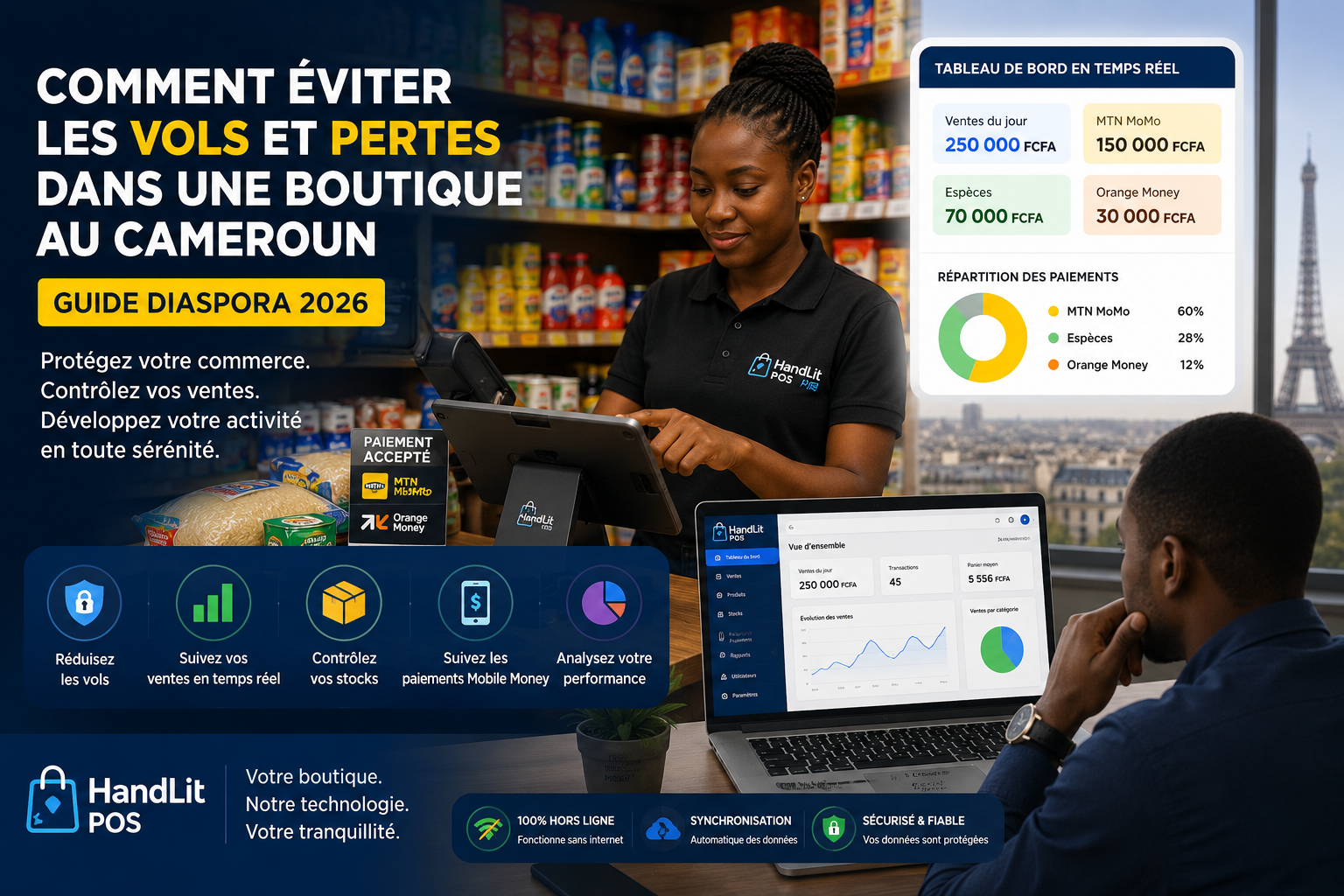
How to Prevent Theft and Loss in a Boutique in Cameroon | Diaspora Guide 2026
Learn how to reduce theft, losses, and cash discrepancies in a boutique in Cameroon through better stock management, Mobile Money, and remote sales.
How to Prevent Theft and Loss in a Boutique in Cameroon | Diaspora Guide 2026
For many Cameroonians living in France, Belgium, Canada, or elsewhere in the diaspora, opening a boutique in Cameroon represents a real opportunity.
But after a few months, many encounter the same problems:
money disappearing,
inconsistent stock,
sales that are impossible to verify,
employees that are difficult to manage,
or figures that never match.
In some businesses, losses become so significant that the owner ends up closing the shop despite good sales.
The most frustrating part?
These losses are often invisible at first.
In this comprehensive guide, you will discover:
the most common types of theft in boutiques in Cameroon,
why businesses managed remotely are more exposed,
how to reduce losses,
and what tools to implement to protect your business.
Why Losses Silently Destroy Businesses
In many boutiques, losses do not come from a single large theft.
They instead come from:
small amounts taken every day,
unrecorded sales,
cash register errors,
products that "disappear",
or poorly tracked Mobile Money payments.
The problem is that remotely, these losses become very hard to detect.
A business can seem to operate normally:
customers are present,
sales continue,
stock is being replenished,
but actual profits gradually vanish.
The Most Common Types of Theft in Boutiques in Cameroon
1. Unrecorded Sales
This is probably the most common issue.
The customer pays normally:
in cash,
or via Mobile Money.
But the sale is never recorded in the cash register.
The money then remains unaccounted for.
Without a digital cash system, it becomes almost impossible to detect these ghost sales.
2. Mobile Money Payments to Personal Numbers
In many businesses:
the cashier receives payments on their phone,
or uses their own MTN MoMo or Orange Money number.
The risk is huge.
A payment can be:
deleted,
intentionally forgotten,
or never reported.
For owners in the diaspora, Mobile Money often becomes the least controlled aspect of the business.
3. Stock Losses
Stock losses are often underestimated.
They can come from:
internal theft,
inventory errors,
products sold without being recorded,
or goods discreetly taken out.
When stocks are not tracked automatically, discrepancies become normal… until the losses become significant.
4. False Daily Reports
Some managers send:
modified figures,
incomplete sales,
or reports that are impossible to verify.
From afar, many owners have no way of confirming the data received.
Why Businesses Managed from Abroad Are More Exposed
When you live in Europe or North America, you cannot:
physically check stock,
monitor sales,
control cash collections,
or observe the daily operations of the business.
You are completely dependent on:
the manager,
the employees,
and the information they choose to share.
Even with a trusted person, the absence of a system creates gaps.
The problem is not just dishonesty.
It is also:
a lack of organization,
human errors,
and a lack of traceability.
The Most Common Mistakes of Diaspora Owners
Trusting Without a System
Trust alone is never enough in a business.
Even a close person can:
forget sales,
mismanage stock,
or make repeated mistakes.
A good system protects:
the owner,
but also the honest staff.
Managing Only via WhatsApp
Many owners request:
photos,
videos,
or daily WhatsApp messages.
But this does not replace:
a sales history,
stock tracking,
or proper accounting.
Not Regularly Checking Stock
Stock is where money disappears most quietly.
Without monitoring:
it is impossible to know what is actually sold,
impossible to detect losses quickly.
Waiting Months Before Setting Up a Cash Register
The longer bad habits take hold, the more difficult they become to correct.
Setting up a system from the start avoids a lot of problems.
How to Reduce Theft in a Boutique in Cameroon
1. Use a Digital Cash Register
A digital cash register allows:
each sale to be recorded,
identification of the cashier,
tracking of payments,
and keeping a complete history.
This greatly reduces invisible manipulations.
2. Separate Payment Methods
Cash, MTN MoMo, and Orange Money must be tracked separately.
Otherwise:
discrepancies become impossible to understand,
and diversions become easier.
3. Check Stock in Real Time
Each sale should automatically reduce stock.
Thus:
discrepancies appear quickly,
missing products are visible,
and anomalies become detectable.
4. Check Reports Daily
A good system allows you to review:
daily sales,
payments,
cancellations,
most sold products,
and any discrepancies.
A few minutes a day can prevent significant losses.
How HandLit POS Helps Reduce Losses
HandLit POS was designed for African businesses and diaspora owners.
The system allows:
Automatic Sales Tracking
Each transaction is recorded.
Traceability of Mobile Money Payments
You see separately:
cash payments,
MTN MoMo,
Orange Money.
Stock Tracking
Quantities are updated automatically after each sale.
A Remote Accessible Dashboard
From your phone or computer, you can check:
sales,
stock,
performance,
and staff activity.
A Complete Audit Log
Every significant action is recorded:
sales,
deletions,
cancellations,
modifications.
This greatly increases transparency.
Concrete Example: A Boutique in Douala
An owner living in France managed a grocery store in Douala.
Each month:
sales seemed correct,
but profits remained low.
After installing HandLit POS:
several unrecorded Mobile Money sales were detected,
stock discrepancies decreased,
and the owner finally gained real visibility over their business.
Within a few weeks:
losses significantly decreased,
and management became more stable.
Why Modern Businesses Now Use a POS
Today, managing a boutique solely with:
a notebook,
a calculator,
or WhatsApp,
has become very risky.
Modern businesses use tools that can:
centralize sales,
track payments,
analyze performance,
and reduce invisible losses.
FAQ - Reducing Theft in a Boutique in Cameroon
How to Control a Boutique from Abroad?
With a connected cash system that allows sales and stock tracking remotely.
Does Mobile Money Increase the Risk of Fraud?
Yes, when not properly tracked in the cash register.
Does a Small Boutique Need a POS?
Yes. Even small businesses can lose a lot of money without tracking.
Does HandLit Work Offline?
Yes. The app works offline and syncs data automatically.
Can Multiple Employees Be Tracked?
Yes. Each user has their own access, and their operations are recorded.
Protect Your Business Today
The majority of losses in African boutiques do not come from a single major issue.
They come from:
small mistakes,
invisible sales,
poorly tracked stock,
and lack of daily control.
With the right tools, it becomes possible:
to reduce losses,
to improve transparency,
and to manage your business remotely with more peace of mind.
Try HandLit POS for free for 30 days and regain control of your boutique in Cameroon.
Get our tips
Tips for better managing your shop, delivered straight to your inbox.