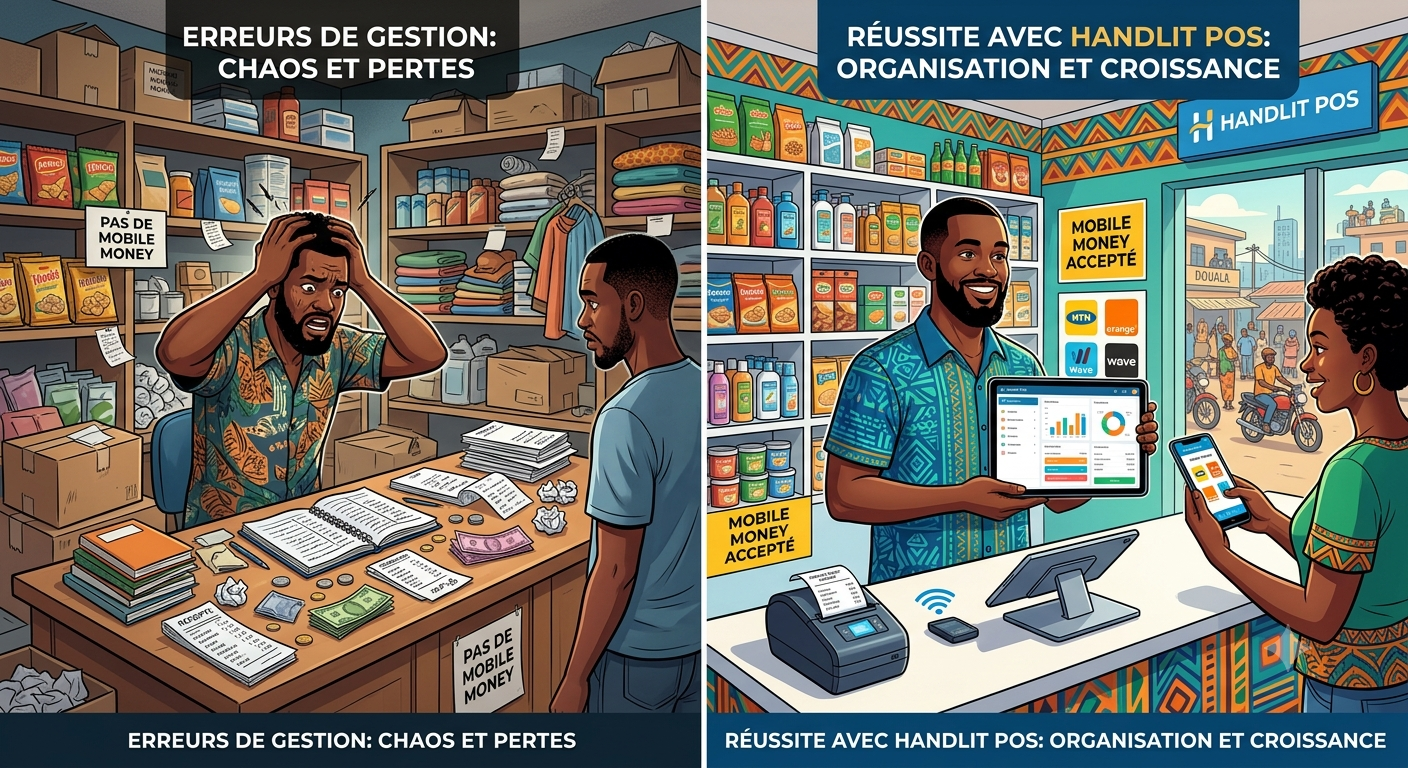
The 20 Business Mistakes New Merchants Make in Africa (and How to Avoid Them)
Discover the 20 most common business mistakes made by new merchants in Africa and our concrete solutions to build a profitable shop.
The 20 Business Mistakes New Merchants Make in Africa (and How to Avoid Them)
Starting your own business is an exciting adventure. Every year, thousands of entrepreneurs open a boutique, grocery store, pharmacy, clothing shop, or hardware store across the continent with the ambition to create a profitable business.
However, many quickly encounter significant difficulties. Not because their products are poor, but because certain business mistakes and management errors, often avoidable, accumulate within the first few months.
The good news? Most of these pitfalls can be corrected with better working methods and modern technological tools. Here’s a breakdown of the 20 most frequent mistakes in business in Africa… and especially our merchant tips to avoid them.
📊 Part 1: Financial Management and Pricing Errors
1. Not Knowing Your Expenses Precisely
Many merchants know how much they sell, but they are unaware of how much they actually spend. Between rent, salaries, transportation costs, taxes, and supplier purchases, these invisible costs weigh down profitability.
Pro Tip: Track every expense down to the last cent to know your true profit.
2. Confusing Revenue and Profit
Making 5 million FCFA in sales does not mean earning 5 million FCFA. Profit corresponds only to what remains after all expenses are deducted. Many shops seem prosperous while generating a near-zero margin.
3. Setting Selling Prices Randomly
Some merchants simply copy the prices of neighboring competitors. Without accurate calculations of your costs and shipping, this practice can destroy your margin and jeopardize the future of a profitable shop.
4. Mixing Personal and Business Money
This is one of the most common and dangerous business mistakes. Regularly taking money from the cash register for family or personal needs without tracking makes any financial analysis impossible. Always strictly separate your two wallets.
📦 Part 2: Pitfalls in Inventory and Logistics Management
+-----------------------------------------------------------------+
|                  THE INVENTORY MANAGEMENT DILEMMA               |
+------------------------------------+----------------------------+
| Too much stock = Dormant money     | Too little stock =        |
| that ties up your cash flow.       | Stock outs and disappointed customers. |
+------------------------------------+----------------------------+
5. Neglecting Inventory Management
Failure to keep a rigorous track leads to significant losses. Regular checks and inventory of your goods help avoid disappointing your buyers or ending up with expired unsold items.
6. Managing Everything Manually in a Notebook
Paper notebooks quickly show their limitations: risks of loss, erasures, endless manual calculations, and frequent cash errors. Digitizing your store management provides unmatched time savings and reliability.
7. Ignoring Your Most Profitable Products
The product that sells the fastest is not necessarily the one that generates the best margin. Analyzing your statistics allows you to focus your sales and promotion efforts on truly lucrative items.
8. Ordering Merchandise Without Forecasting
Buying purely "on instinct" often leads to surpluses or critical stock shortages. Use your sales history to better anticipate your future supplies.
⚡ Part 3: Sales, Technology, and Customer Experience
9. Not Recording All Transactions
Every forgotten or unrecorded sale directly skews your financial results. By the end of the month, it becomes impossible to know your store's actual performance.
10. Refusing Mobile Money Payments
Today, a vast majority of consumers prefer to pay with their smartphones. Not accepting Mobile Money (MTN MoMo, Orange Money, Wave...) shuts the door to many buyers and unnecessarily loses sales.
11. Overlooking Customer Experience Quality
A clean point of sale, a warm welcome, and a quick checkout foster customer loyalty much more than many promotional campaigns.
12. Never Analyzing Sales Statistics
Piloting blindly without reliable data prevents you from spotting growth opportunities. Analyzing figures helps you identify your best days, peak hours, and quiet periods.
👥 Part 4: Management, Marketing, and Strategic Tools
13. Giving Employees Full System Access
Not every employee needs to see your margins or have the ability to modify inventory. Limiting your team's IT access drastically reduces errors and enhances your shop's security.
14. Not Monitoring Your Sellers' Performance
Assessing the individual sales of your employees is crucial to successfully running your store. This allows you to motivate your top performers, adjust training, and set realistic goals.
15. Neglecting Communication and Digital Marketing
Even the best shop in the neighborhood needs visibility. Regularly post on your channels (Facebook, Instagram, TikTok, or WhatsApp Business), as traditional word of mouth is no longer enough in 2026.
16. Failing to Prepare for High Demand Periods
The end-of-year holidays, fasting periods, or back-to-school times lead to significant increases in activity. Anticipating your stock needs helps you avoid missing the biggest events of the year.
17. Waiting Until a Critical Problem Arises
Successful merchants detect anomalies before they cause damage: sudden declines in margins, decreased average purchase value, or abnormally low stock levels.
18. Ignoring or Dismissing Customer Feedback
Your buyers' opinions are a gold mine for refining your hours, adjusting your prices, or improving the overall quality of your services.
19. Running Your Point of Sale Solely on Intuition
While hands-on experience is valuable, decisions based on real reports and precise figures are infinitely more profitable and secure.
20. Refusing to Invest in Modern POS Software
Trying to save in the short term on your management tools costs much more in the long run due to human errors and missed opportunities.
How Handlit POS Helps You Eliminate These Management Errors
To secure your investment and grow your business smoothly in Cameroon, Côte d'Ivoire, Senegal, or Gabon, using suitable technology is essential. This is precisely what Handlit POS was designed for.
Daily Mistakes Handlit POS Provides Concrete SolutionsManaging on paper notebooks: Centralizes your sales on a simple, intuitive app.Change-making ErrorsInstant calculations and direct integration of Mobile Money.Inventory OmissionsAutomatically updates your stock management with every sale.Fraud or Employee ErrorsAssigns roles and secure permissions for each seller.Frequent Internet OutagesOffline-First mode to continue selling even without network connectivity.
Conclusion: Take Control of Your Business Success
Success in business in Africa does not solely depend on the quality of the products showcased. It primarily relies on rigorous financial management, excellent knowledge of your numbers, and responsiveness to your customers' needs.
By avoiding these 20 mistakes from the outset, you will protect your valuable cash flow and increase your chances of building a sustainable and flourishing enterprise.
Don’t let chance dictate the future of your business. Equip yourself with Handlit POS today and transform your point of sale into a true engine of profitable growth!
Get our tips
Tips for better managing your shop, delivered straight to your inbox.