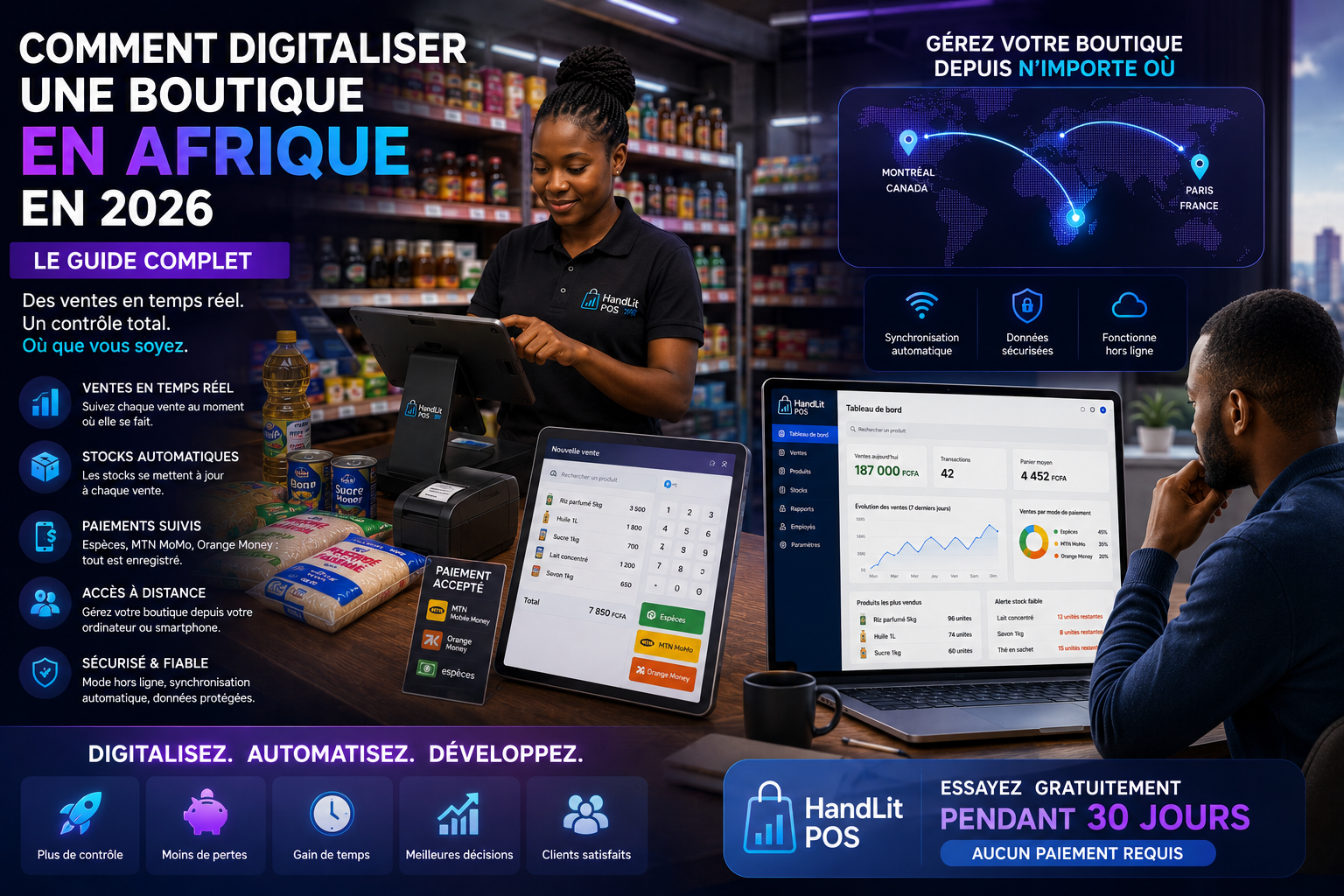
How to Digitize a Shop in Africa in 2026 | Complete Guide for Modern Merchants
Discover how to digitize your shop in Africa using Android POS systems, Mobile Money, inventory tracking, and real-time dashboards.
How to Digitize a Shop in Africa in 2026 | Complete Guide for Modern Merchants
For a long time, African businesses operated using:
notebooks,
calculators,
paper receipts,
and a lot of manual management.
And for a long time, that seemed sufficient.
But today, commerce is changing rapidly in Africa.
Customers now pay using:
MTN Mobile Money,
Orange Money,
Wave,
credit cards,
or QR codes.
Merchants need to:
track their inventory,
manage their employees,
analyze their sales,
and sometimes manage their shop remotely from Europe or Canada.
In this new context, continuing to manage a shop solely with a notebook becomes risky.
This is where digitization comes in.
Digitizing a shop does not mean turning a small business into a large tech company.
It simply means:
better organizing sales,
reducing losses,
automating certain tasks,
and finally gaining true visibility into business operations.
In this complete guide, you will discover:
what it really means to digitize a business in Africa,
the most important tools,
the mistakes to avoid,
and how solutions like HandLit POS allow African merchants to modernize their operations with ease.
Why African Businesses Are Rapidly Digitizing
In recent years, several changes have profoundly transformed commerce in Africa.
Mobile Money Has Changed Habits
In countries like:
Cameroun,
Senegal,
Côte d'Ivoire,
or Congo,
a large part of payments is now made through mobile phones.
Customers use daily:
MTN MoMo,
Orange Money,
Wave,
Airtel Money.
This completely changes how a shop is managed.
Merchants now need to:
track multiple payment methods,
manage digital transactions,
and avoid accounting errors.
Merchants Want More Control
Today, many shop owners want to:
track their sales in real-time,
manage their inventory,
reduce losses,
and make better decisions.
Manual methods can no longer do this effectively.
The Diaspora Is Investing More
Many Africans living:
in France,
Belgium,
Canada,
or the United States,
are opening businesses back in their home countries.
But managing a business remotely without digital tools becomes very complicated.
Digitization allows for:
remote sales tracking,
data analysis,
and monitoring operations without being physically present.
What Does It Mean to Digitize a Shop?
Many imagine it requires:
complicated machines,
expensive software,
or substantial infrastructure.
In reality, digitizing a shop mainly means:
replacing manual methods,
automating certain tasks,
and centralizing important information.
Moving from Notebooks to a Digital System
In a traditional shop:
sales are hand-written,
calculations are done manually,
inventory is approximate,
and errors are frequent.
With a digitized shop:
each sale is recorded automatically,
inventory updates itself,
payments are tracked,
and all data becomes accessible.
Essential Tools for Digitizing a Shop
1. A Digital Cash Register (POS)
This is the heart of the system.
A POS allows:
sales recording,
receipt printing,
payment tracking,
and automatic inventory management.
Today, Android POS systems are particularly popular in Africa because they are:
affordable,
easy to use,
and suitable for small businesses.
2. An Inventory Management System
Inventory represents your business's money.
Without precise tracking:
losses become invisible,
stockouts increase,
and orders become disorganized.
A digital system allows for:
viewing remaining quantities,
identifying best-selling products,
and anticipating stockouts.
3. Mobile Money Tracking
Mobile Money has become essential.
A modern shop must be able to track:
MTN Mobile Money,
Orange Money,
Wave,
or any other mobile payments.
Each transaction must be:
recorded,
separate from cash,
and visible in reports.
4. A Real-time Dashboard
The dashboard allows the owner to see:
daily sales,
performance metrics,
inventory levels,
payments,
and employee activity.
This is especially important for:
diaspora owners,
multi-store businesses,
or very busy entrepreneurs.
Why Manual Methods Are Becoming Dangerous
Many businesses still use:
a notebook,
a calculator,
or Excel.
But this quickly creates problems.
Human Errors Increase
Manual calculations lead to:
omissions,
incorrect totals,
inventory errors,
or unrecorded sales.
Losses Become Invisible
Without digital history:
it’s impossible to verify figures,
impossible to analyze anomalies,
impossible to detect certain losses.
No Remote Visibility
An owner living abroad relies solely on:
phone calls,
WhatsApp messages,
or reports from the manager.
This greatly limits real control over the business.
Why Android POS Is Becoming the Norm in Africa
Android POS systems perfectly meet African realities.
They Are Affordable
No need for:
expensive computers,
complex hardware,
or heavy installations.
A simple Android tablet is often enough.
They Are Easy to Use
Staff learns quickly:
to record sales,
select products,
and process payments.
They Operate Offline
This is essential in Africa.
The best POS solutions allow:
sales to continue without the Internet,
and then automatically sync data later.
They Allow for Remote Management
The owner can view:
sales,
inventory,
payments,
and reports,
from anywhere in the world.
How HandLit POS Helps African Businesses Digitize
HandLit POS was specifically designed for:
African businesses,
ground realities,
and the needs of the diaspora.
A Solution Tailored for Africa
The system takes into account:
internet outages,
Mobile Money,
small businesses,
and local constraints.
Offline Operation
Sales continue even without connectivity.
As soon as the Internet returns:
everything syncs automatically.
Comprehensive Sales Management
Each sale records:
the product,
the quantity,
the price,
the payment method,
and the responsible cashier.
Accessible Dashboard Anywhere
From:
Paris,
Brussels,
Montreal,
Douala,
or Yaoundé,
you can monitor your shop in real-time.
Mobile Money Payment Tracking
HandLit automatically separates:
cash payments,
MTN MoMo,
Orange Money.
This enhances:
transparency,
control,
and accounting.
The Concrete Benefits of Digitalization
Less Loss
Sales are better tracked.
More Control
Owners finally see the real data.
Better Organization
Inventory and sales become clearer.
Time Savings
Less manual calculations and checks.
Smarter Decisions
Statistics help understand:
profitable products,
trends,
and performance.
FAQ - Digitizing a Shop in Africa
Can a small shop be digitized?
Yes. Even small businesses benefit greatly from a POS system.
Does a digital cash register work without the Internet?
Yes. HandLit POS works offline.
Is Mobile Money integrated?
Yes. MTN MoMo and Orange Money can be tracked directly.
Is a computer necessary?
No. An Android tablet is usually sufficient.
Can you manage your shop from abroad?
Yes. The dashboard is accessible from anywhere.
The African Commerce Goes Digital
Commerce in Africa is evolving rapidly.
Shops that still use only:
notebooks,
calculators,
and manual methods,
are gradually at risk of losing efficiency and control.
Digitizing your shop allows you to:
improve your management,
reduce losses,
track your activity in real-time,
and grow your business more confidently.
With HandLit POS, digital transformation becomes simple, accessible, and adapted to African realities.
Try HandLit POS for free for 30 days and modernize your shop today.
Get our tips
Tips for better managing your shop, delivered straight to your inbox.