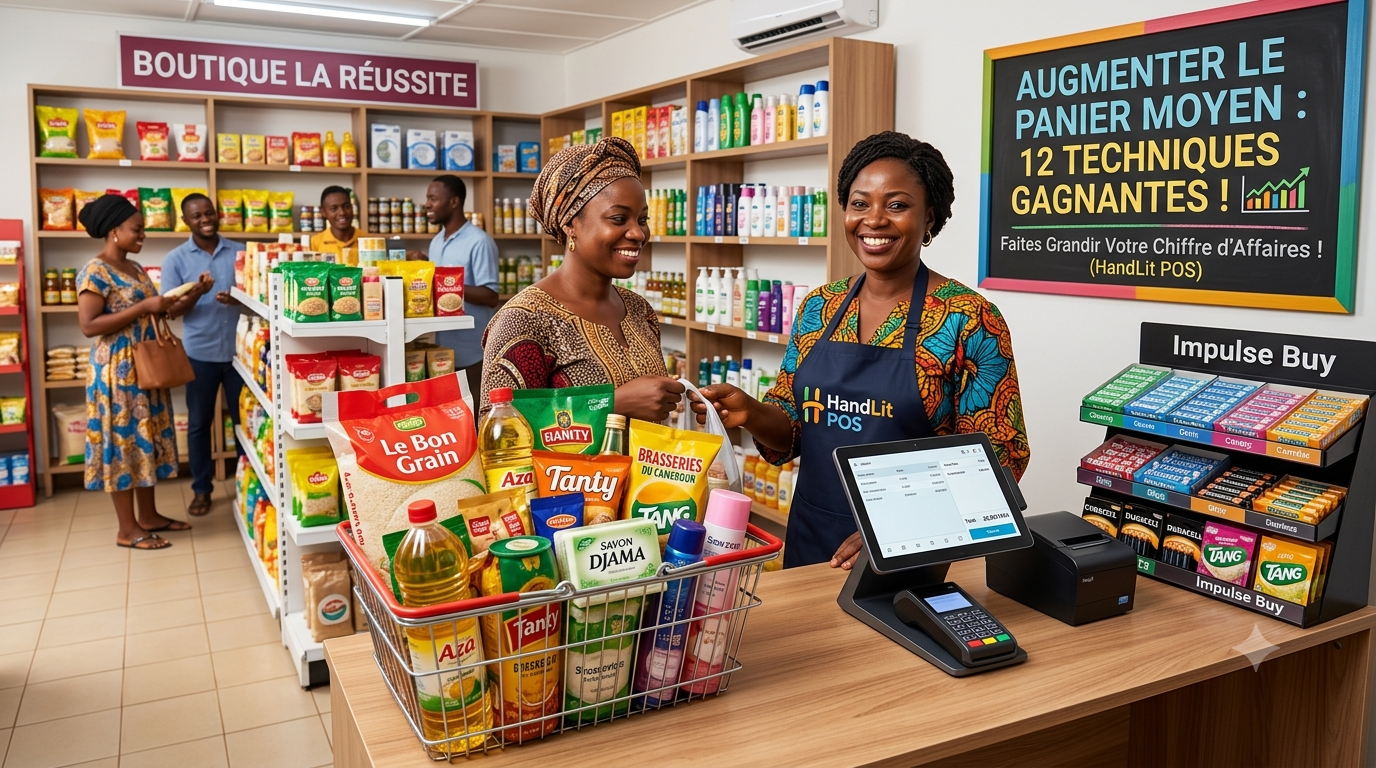
How to Increase the Average Basket Size of Your Shop in Cameroon in 2026
Discover 12 simple techniques to increase the average basket size of your shop in Cameroon. Practical tips for selling more without attracting more customers.
How to Increase the Average Basket Size of Your Shop in Cameroon: 12 Proven Techniques
When sales stagnate, many shop owners immediately think: “I absolutely need to attract more customers.”
However, this is often the longest and most expensive route. There is a much simpler, quicker, and more profitable solution: increase the average amount spent by each customer.
The Multiplier Effect of the Average Basket
Let’s take a concrete example:
Your shop welcomes about 80 customers a day. If each customer spends an average of 2,000 FCFA, your daily revenue is 160,000 FCFA.
If, through a better strategy, you increase this average basket to 2,300 FCFA (+300 FCFA only), without attracting a single additional customer, your daily revenue rises to 184,000 FCFA.
Result: You gain an additional 24,000 FCFA each day. Over a month, that’s more than 700,000 FCFA in extra revenue that goes into your cash register, without spending a franc on advertising.
What is the Average Basket Size?
The average basket size is the indicator that measures the average amount a customer spends in your shop at each checkout. The formula is simple:
$$\text{Average Basket} = \frac{\text{Total Revenue}}{\text{Number of Sales (Receipts)}}$$
It is one of the most important indicators for measuring the performance of a business. Two shops may serve the same number of customers, but the one that masters its average basket will always be the most profitable.
12 Concrete Techniques to Boost Your Receipt Amount
1. Cross-selling
Don’t just sell one product; sell a complete solution. If a customer buys pasta, offer them tomato sauce or oil. If they buy a toothbrush, suggest toothpaste.
2. Create Bundle Offers
Customers love the feeling of getting a deal. Offer "Smart Packs": Rice + Oil + Tomatoes or Soap + Detergent. The customer buys more in one go.
3. Impulse Purchase Zone (Near Checkout)
The checkout area is the most valuable part of your shop. Place low-cost items there that are decided on at the last moment: chewing gum, batteries, tissues, snacks, or phone accessories.
4. Train Your Staff in Sales
A knowledgeable team is a team that sells more. Encourage your sellers to ask simple questions: “Did you forget to get the...?” or “To go with this product, we also have...”.
5. Optimize Shelf Presentation
Merchandising isn’t just for supermarkets. Group complementary products together (e.g., coffee next to sugar). A logical path encourages the customer to fill their basket naturally.
6. Highlight New Arrivals
Regular customers get used to your stock. Create a clearly visible "New Arrivals" or "Latest Arrivals" area. Curiosity often leads to additional purchases.
7. Identify "Margin-Generating" Products
Not all products are created equal. Identify the items that offer the best profitability and showcase them. Don’t just sell the products everyone asks for (which often have very low margins).
8. Strict Management of Stockouts
Nothings kills the average basket size more than an empty shelf. If a customer can’t find the main product, they won’t be able to buy complementary items. Availability is your first sales weapon.
9. Adapt the Offer to Seasons and Context
The average basket varies according to the calendar. Before the back-to-school season, it’s time for supplies. Before holidays, it’s time for luxury food items or drinks. Be responsive.
10. The Power of Data
Intuition-based decisions are risky. Analyze your receipts: what are the peak hours? Which products are often bought together?
11. Reward Loyalty
A loyal customer is one who comes back more often and is more inclined to try new products. A simple point accumulation system or exclusive benefits strengthens that commitment.
12. Weekly KPI Tracking
What is not measured cannot be improved. Check your average basket each week. If the figure stagnates, test a new technique (a pack, a promotion) and see if the number rises.
How HandLit POS Transforms Your Data into Revenue
Increasing your average basket size requires visibility into what is really happening in your shop. HandLit POS acts as a real dashboard for your profitability:
Real-time Tracking: Check your daily average basket with one click.
Cross-selling Analysis: Identify which products your customers are buying together to better organize your shelves.
Product Performance: Instantly detect which items are driving your basket size up and which are stagnating.
"You can’t manage what you can’t measure."
With HandLit POS, you stop guessing and start steering your growth with precise figures.
FAQ: Your Questions About Average Basket Size
What is a "good" average basket size?
There is no magic number. It depends on your sector (food vs. cosmetics). The important thing is to compare your average basket today with last month’s. The trend should be upwards.
Do I need to increase prices to raise my average basket size?
No! It’s often the opposite that needs to be done. It’s better to sell more products at a fair price than to sell fewer products at a price too high that will drive your customers away.
Why is following the average basket size crucial?
Because it is the simplest indicator of whether your sales strategy is working. If you have traffic but your average basket is low, you are working too hard for not enough profit.
🚀 Ready to Boost Your Revenue?
Increasing the average basket size is the most profitable strategy for growing a shop. By combining organization, sales advice, and precise data, you turn every customer visit into an opportunity for growth.
Do you want to track your average basket in real-time and run your shop like a pro?
👉 Find out how HandLit POS can help you increase your sales starting today
Get our tips
Tips for better managing your shop, delivered straight to your inbox.